Showing posts with label facebook. Show all posts

Tuesday, 7 June 2016

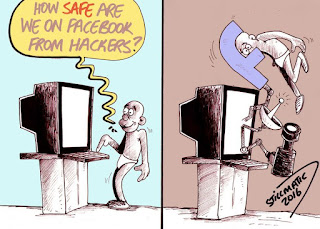
Hackers everywhere!!! Zuckerberg’s social media accounts hacked!!! Learn how to protect your's


"Hackers, hackers everywhere,social media is safe no more!".

Facebook CEO Mark Zuckerberg would be one person you’d think would use good security to protect social media accounts. Apparently,even billionaire tech entrepreneurs get hacked.

Facebook Inc.’s first “security tip” for users is, “Don’t use your Facebook password anywhere else online.”

But, its founder did not heed that advice.


Mr. Zuckerberg’s Twitter Inc. and Pinterest Inc. accounts were taken over on Sunday because he reused a password: “dadada”. The password had appeared last month in a database of more than 100 million usernames and passwords stolen in 2012 from LinkedIn Corp. Mr. Zuckerberg appears to have reused “dadada” to log into Twitter and Pinterest, allowing hackers to take over those accounts. 

The hacker group OurMine took responsibility, and claimed they were just trying to raise awareness.


How hackers hack Facebook Account

Inorder to learn how to protect your social media acoounts you must first understand how hackers hack ocial media acoounts

Email Address Hack


For email address hack, all a hacker needs to do is know your name and he will be conveniently shown your email address at your Facebook profile. Then hacker's can hack your Facebook account (and everything else associated with that email id) if he 'guesses' your password (if you use a weak password) or answers your security question! This is something I hope Facebook improves on quickly.


Phishing

Phishing is one of the easiest ways to trick users into giving out their login credentials. All a hacker does is setup a webpage similar in design to that of the Facebook homepage, attach a server sided script to track the username and password entered and store it in a log. Sending people emails stating that someone tagged a photo of them on Facebook in the same format as Facebook and giving a link below to the phishing website further reduces the chances of it being detected as a fake. Sometimes, spam Facebook apps, like those promising to tell who viewed your Facebook profile, automatically post links to phishing websites. A new trend amongst phishers is creating Facebook look-a-like widgets for stealing user's login credentials.

Key logging through Keyloggers

Keylogger is a type of computer virus that tracks key strokes. Keyloggers can be installed remotely on a computer system by a cracker to record all the activity that is going on the victim's computer. Keylogging gets more easy if the hacker has physical access to the victim's computer.

Social Engineering

Social engineering involves using any trick to fool the user into making himself vulnerable to exploits. This could involve anything from sending spoof emails, pretending to be from Facebook, telling you to change your password to 12345678 to a hacker maliciously getting out the answer to your security question in a friendly chat or discussion.


Now the question is "How to prevent your Facebook Account from being Hacked?"

Following Three Security Options makes your Facebook Account Secure and Hack Proof.

1.You can enable Login Notification so that whenever any body (or a hacker) tries to login with your User ID and Password, you will receive a Notification on your cell phone and you will come to know that it's time to change your password right now because the hacker has got your password and is trying to log in to your Facebook Account.

To Enable Login Nofication
Go to Home -> Account Settings -> Security -> Login Notification

Put a Check Mark on your preffered option and

click Save Changes button.


2.Always check your Active Sessions. If you notice any unfamiliar location or device, it means your Facebook Account is at risk. Just click on End Activity and dont forget to change your password after that.

To Check Active Sessions
Go to Home -> Account Settings -> Security -> Active Sessions.

3.Enable Secure Browsing to make your account more secure.
Go to Home-> Account Settings -> Security -> Secure Browsing.


Sources: Google,CNBC.com,bgr.com

Friday, 3 June 2016

Is Technology Stealing Our (Self) Identities?


Who or what is defining your self-identity?

Our self-identities, that is, how we define and see ourselves as unique individuals, play a vital role in who we are and the direction that our lives take. The self-identity encompasses the totality of knowledge and understanding that we gain about ourselves as we develop including our personalities, aptitudes and capabilities, intellectual and physical attributes, interests, and relationships.

We gain our self-identities in two ways. First, as we develop self-awareness, we observe and evaluate our thoughts, feelings, and behavior based on past experience, current needs, and future goals. We also look outward to the world in which we live, for example, social, academic, and physical, for feedback that also shapes our self-identities. Because we are fundamentally social beings and an essential part of our development involves finding our place in the social and cultural context in which we live, feedback from that social world plays a significant role in the evolution of our self-identities.

Because our social worlds have expanded dramatically in the last decade, from families, friends, neighborhoods, and schools to an almost-limitless universe of people due to the proliferation of the Internet and social media, it isn't difficult to see how external forces may now be gaining a disproportionate influence over our self-identities compared to previous generations. And these social influences, accelerated by the recent explosion of technology, is shaping our self-identities in ways in which most of us aren't the least bit aware. 


One of the most powerful ways in which technology is altering self-identity is through the shift from being internally to externally driven. Yes, as I just described, social factors have always had an impact on the formation of self-identity, but they had been, up until recently, partners of sorts with our own internal contributors to self-identity. But now the sheer ubiquity and force of the latest technological advances has taken that influence and turned its volume up to a deafening roar.

In previous generations, most of the social forces that influenced our self-identities were positive; parents, peers, schools, communities, extracurricular activities, even the media sent mostly healthy messages about who we were and how we should perceive ourselves. Yes, there were bad influences, but they were far outweighed by those that were beneficial. These forces acted mostly as a mirror reflecting back on us what we saw in ourselves, resulting in affirmation rather than change in our self-identities.

But now, the pendulum has swung to the other extremes in a social world where the profit motive rules and healthy influences are mostly drowned out by the cacophony of the latest technology. The self-identities of this generation of young people and, in fact, anyone who is deeply immersed in popular culture and media, are now shaped by external forces in two ways.

First, popular culture, through both "old-school" and the latest media, no longer holds a mirror to reflect our self-identities. Nor does it provide feedback about how grounded our self-identities are in the reality of our lives. Instead, popular culture manufactures "portraits" of who it wants us to be. Tapping into our most basic needs to feel good about themselves, accepted, and attractive, popular culture tells us what we should believe about ourselves. The problem is that the self-identity that is shaped by popular culture serves its own best interests rather than what is best for us. Additionally, self-identity is no longer self-identity, meaning derived from the self, but rather is an identity projected onto us by popular culture and in no way an accurate reflection of who we really are.

Second, social media has caused us to shift away from expressing our self-identities and toward constructing facades based on the answers to these questions, "How will others look at me?" and "How can I ensure that others view me positively?" The goal for many now in their use of social media becomes how they can curry acceptance, popularity, status, and, by extension, self-esteem through their profiles and postings. Self-awareness and self-expression give way to impression management and self-promotion. As the writer Christine Rosen observed in her 2007 article in The New Atlantis, "Does this technology, with its constant demands to collect (friends and status), and perform (by marketing ourselves), in some ways undermine our ability to attain what it promises-a surer sense of who we are and where we belong? The Delphic oracle's guidance was know thyself. Today, in the world of online social networks, the oracle's advice might be show thyself." 


We come to see our identities as those we would like to have or that we want people to see rather than who we really are. We then feel compelled to promote and market these identities through social media. The line between person and persona, private and public self become blurred or erased completely and the so-called self-identity becomes a means of our acceptance and status.

Paradoxically, in striving for approval by our social world writ large through technology and in seeking uniqueness that enables us to stand out in the densely populated cyber world, we unwittingly sacrifice our true self-identities and shape our identities to conform to what the digital world views as acceptable identity. And, in doing so, we relinquish the specialness that we hold so dear. Notes Christine Rosen, "Indeed, this is one of the characteristics of MySpace [obviously before Facebook took off]...it is an overwhelmingly dull sea of monotonous uniqueness, of conventional individuality, of distinctive sameness." 


There are two really sad things about this unintended consequence of the use of these emerging technologies. First, most people have no idea of the dramatic changes that are occurring slowly yet inexorably within them (just as a frog doesn't sense it is going to die if placed in water that is heated slowly). Second, this shift in identity, from internally derived to externally driven, can't be good for us as (formerly unique?) individuals nor for us as a (formerly vital?) society.

Thursday, 2 June 2016

Deep Text-Facebook's text understanding AI!


There is just way too much offensive content in many Facebook posts.You are frustrated and want to do something about it.But,reporting these posts can be such a drag!Don't worry!An AI is coming to your rescue!

Facebook has announced the development of a new artificial intelligence(AI) that can analyse what people are writing about in posts with near-human accuracy across 20 languagesIt can automatically pick out hate speech from status updates that merely contain controversial terms, it could prevent a human from ever suffering the harassment and having to report it manually.Facebook already says that its AI systems report more offensive photos than humans on its social network.

The applications of 'Deep Text' are big! Facebook knows what your status update is about, it can show it to people who care about that topic. If it understands the difference between “I just got out of the taxi” and “I need a ride” messages, it can ask if you want an Uber. If it detects that you’re trying to sell something in a status update, it can automatically format post with the price and item details. And if Facebook can determine what kinds of comments on celebrities’ posts are interesting and not just “OH MY GOSH I LOVE YOU”, it can surface ones you’ll actually want to read.


Facebook explains that “to get closer to how humans understand text, we need to teach the computer to understand things like slang and word-sense disambiguation. As an example, if someone says, “I like blackberry,” does that mean the fruit or the device?"

Of course, the privacy implications might rattle some people. Facebook is now highlighting that it scans the content of your private messages — something that made Facebook the target of a class-action lawsuit in the past.But I feel that the advantages of 'Deep Text' outweigh the concerns about privacy.

With 'DeepText' and its other image recognition AIs, Facebook could make huge improvements in how it routes content from authors to viewers. That could give it a leg-up over other social networks like Snapchat or Twitter without the know-how or product design to aggressively filter and suggest what people see.

The gap between the AI haves and have-nots is widening. If every News Feed post looks interesting, you’ll spend more time on Facebook, you’ll share more text there, DeepText will get smarter, and the Facebook AI feedback wheel will spin faster and faster towards becoming the perfect content recommendation engine.